






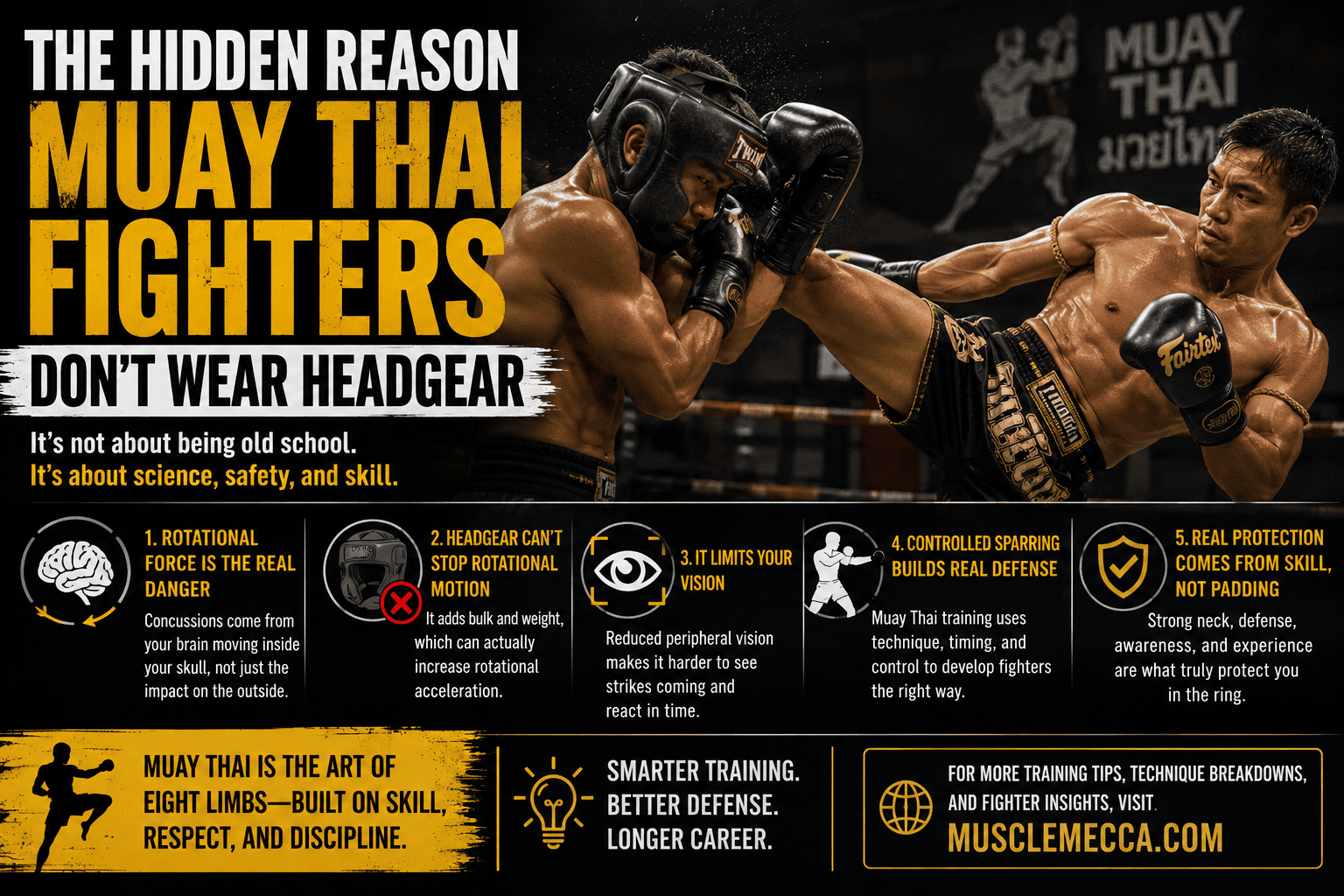
Headgear might look like an obvious way to make Muay Thai safer, but its protective role is more complicated than simply putting padding between a fighter’s head and an incoming strike. It can help reduce cuts and some forms of facial trauma, yet research has not established that conventional combat-sports headgear reliably prevents concussion or other traumatic brain injuries. The bigger question is what happens to the head and brain during the rapid acceleration and rotation created by strikes.
That distinction matters because headgear is designed primarily to manage external impact. It cannot eliminate all of the forces transmitted through the head, and researchers continue to debate how much protection it provides against the mechanisms associated with concussion.
The Brain Science Behind Headgear and Impact
Headgear can provide meaningful protection against certain types of injury. Padding can reduce the severity of cuts, abrasions, and some direct impact forces, which is one reason protective equipment remains common in combat-sports training.
Brain injury, however, is more complicated. During a hard strike, the head can experience both linear and rotational acceleration. Rotational acceleration is particularly important in traumatic brain injury research because rapid rotational movement can cause the brain to move and deform within the skull. A systematic review of combat-sports research found that direct head strikes can generate substantial rotational acceleration, although the researchers emphasized that sport-specific conclusions about headgear remain difficult because the available studies use different methods and equipment.
In other words, wearing headgear should not create the impression that a fighter is protected from concussion. It may provide useful protection against some injuries while leaving other mechanisms of brain injury largely unresolved.
The Rotational Force Problem Headgear Can’t Completely Solve
Consider a roundhouse kick or hook that catches the side of the head. The impact doesn’t simply push the head backward. Depending on the location and direction of the strike, it can also cause the head to rotate rapidly.
That rotational component is one reason researchers study head acceleration rather than looking only at the force of the surface impact. The 2022 systematic review of combat-sports research found that rotational acceleration was strongly associated with traumatic brain injury and that direct strikes in striking sports could generate particularly high rotational loads.
However, it would be inaccurate to claim that headgear necessarily makes rotational acceleration worse. The evidence does not support such a simple conclusion. In some laboratory boxing studies, headgear actually reduced measured rotational acceleration, while other research has found that the effectiveness varies according to headgear design, impact location, and testing conditions.
That is why the more accurate takeaway is that headgear cannot be treated as a guarantee against concussion. Protective equipment can reduce certain forms of impact without eliminating the underlying risk created by repeated head strikes.
Why Studies Question Whether Headgear Prevents Concussion
The central question isn’t whether headgear does anything. It clearly can. The question is whether it prevents the type of brain injury fighters and coaches are most concerned about.
Research has produced mixed results. A systematic review of combat-sports biomechanics found that the role of headgear remains contentious and that more prospective research is needed. Some laboratory testing has shown reductions in impact acceleration with certain headgear designs, while other testing has demonstrated that existing equipment does not consistently eliminate potentially significant impact forces.
There is also a practical trade-off. Bulky headgear can affect comfort, fit, peripheral vision, and the way a fighter perceives incoming strikes. Those factors can matter during sparring, although claims that headgear universally increases the number of strikes a fighter receives have not been conclusively established. Researchers have specifically identified these proposed effects as areas requiring further investigation rather than settled facts.
So the issue isn’t that headgear is useless. It’s that fighters should understand what it is—and isn’t—designed to protect against.
Why Muay Thai Sparring Relies on Controlled Impact
One of the most important safety tools in Muay Thai isn’t a piece of equipment at all. It’s the way training is conducted.
Good sparring is built around control, technical development, and appropriate intensity. Fighters learn to manage distance, recognize attacks, defend intelligently, and develop timing without turning every training session into a full-power fight.
That approach matters because repeated head impacts are a significant concern in striking sports. The combat-sports literature shows that potentially dangerous head acceleration can occur during both competition and training, reinforcing the importance of managing exposure rather than assuming protective equipment eliminates the risk.
For fighters interested in Muay Thai technique and training, MuscleMecca’s guide to common Muay Thai roundhouse mistakes provides another look at how technical execution, positioning, and defensive habits affect performance.
The Real Ways Muay Thai Fighters Manage Head-Injury Risk
Because headgear is not a complete solution to concussion risk, responsible Muay Thai training uses multiple layers of risk management.
The first is controlled sparring. Keeping unnecessary head contact out of routine technical sessions can reduce exposure to repeated impacts. Coaches can also adjust intensity, pair athletes appropriately, and stop sessions when a fighter shows signs of injury.
The second is defensive skill. Distance management, guard positioning, footwork, parrying, blocking, and controlled head movement all reduce opportunities for clean strikes. These skills do not make a fighter immune to concussion, but they are fundamental components of competent striking defense.
The third is appropriate protective equipment. Headgear can still have a place in training, particularly when the goal includes reducing facial cuts or other superficial injuries. It should simply be viewed as one layer of protection rather than a concussion-proof shield.
The fourth is recognizing and responding to suspected concussion. The combat-sports literature emphasizes that athletes displaying signs or symptoms consistent with traumatic brain injury should be removed from activity and medically evaluated rather than continuing to train through the symptoms.
So Why Don’t All Muay Thai Fighters Wear Headgear?
The answer isn’t that Muay Thai fighters have discovered that headgear is dangerous or that it provides no protection. The reality is more nuanced.
Different rulesets, gyms, competitions, and training environments use different approaches to protective equipment. Some fighters wear headgear during sparring, while others prefer lighter equipment depending on the type and intensity of training. Competition regulations also vary between organizations.
The important point is that headgear should not be confused with comprehensive brain protection. It can reduce certain forms of trauma, but it cannot guarantee that a fighter will avoid concussion or other brain injury after repeated or significant head impacts.
For anyone training Muay Thai, the strongest safety strategy is therefore layered: sensible coaching, controlled sparring, appropriate protective equipment, strong defensive fundamentals, and immediate medical assessment when concussion is suspected.
If you’re interested in more combat-sports discussion, technique breakdowns, and training content, explore MuscleMecca.